
We’re currently transitioning our admin model from Team > Group to Organization > Team > Group, with admin roles becoming Organization Admin and Team Admin. As a result, some language in this article (for example, references to “Team” or “Group”) may not exactly match what you see in the product today. The underlying functionality described here remains the same, even if the labels and hierarchy in your app look slightly different while we complete this transition.
Note: This article is a deep dive into how milestones and statements are scored for the existing Scoring model v1.0. To see how this compares to the new Scoring v1.1 model, see also: Scoring & Feedback: Model Overview
Overview: Brevity provides instant, objective scoring and actionable feedback on every simulated conversation you complete. This helps you see exactly where you’re excelling and where you can improve, accelerating your progress as a business development rep.
- What is Scored in Brevity?
- Where to Find your Scores
- What Kind of Feedback Will I Get?
- How Scores are Calculated
- How to Interpret your Scores
- Why This Matters / Value to You
- FAQs
Note on Scoring and Feedback Access: Members can only see their own detailed scores and feedback. Admins (Organization Admins and Team Admins) can review scores and feedback in depth for anyone in their organization or assigned team.
If you don’t see scoring details for other users, you may not have the correct admin permissions.
What is Scored in Brevity?
When you finish a role play, Brevity evaluates your performance based on two main areas:
1. Milestones
- Definition: Key objectives or checkpoints for your call—think of them like steps you must achieve to have a successful conversation (e.g., "Build rapport," "Uncover pain," "Book demo").
- Scoring: Passing each milestone is crucial and carries significant weight in your overall score.
2. Communication Quality
- Definition: Each response or message you provide during the conversation.
- Scoring: Every statement is evaluated for relevance, clarity, persuasiveness, and alignment with the scenario.
- Statement Score: You receive a score for each, and your average statement score contributes to your final result.
Note on practice modes and statement scoring:
- Scripts mode: Statement scoring includes script adherence. To reach 90–100, you must read and use the provided script; averages below 90 usually mean the script wasn’t followed closely.
- Hints or None: No script-adherence component. You’re scored on clarity, relevance, persuasiveness, and alignment with the scenario; top performance in these modes is capped lower (phenomenal is 81–85).
Where to Find Your Scores
After completing a role play:
-
Summary Score:
- Displayed at the top of your role play report.
- Shows overall performance as a percentage (e.g., 82%).
-
Milestones Breakdown:
- Each milestone displays a ✅ (pass) or ❌ (not met), with color coding.
- The “target milestone” (win condition) is specially marked, showing if the conversation was ultimately won.
-
Statements & Feedback:
- Every statement you made is listed with its individual score.
- Side-by-side feedback/explanations accompany each statement.
What Kind of Feedback Will I Get?
Brevity provides detailed, actionable feedback in the following formats:
-
"Start, Stop, Continue":
- New techniques to try (Start)
- Areas to improve (Stop)
- What you did well (Continue)
- See also: Scoring & Feedback: Start, Stop, Continue Guidance
-
Statement-level Feedback:
- For each statement, you’ll see practical advice or rephrased examples to help you refine your approach.
- See also: Scoring & Feedback: Overview
How Scores are Calculated
How Scores Are Calculated
Your overall performance in a Brevity role play is determined by combining your success on milestones with the average score of your statements.
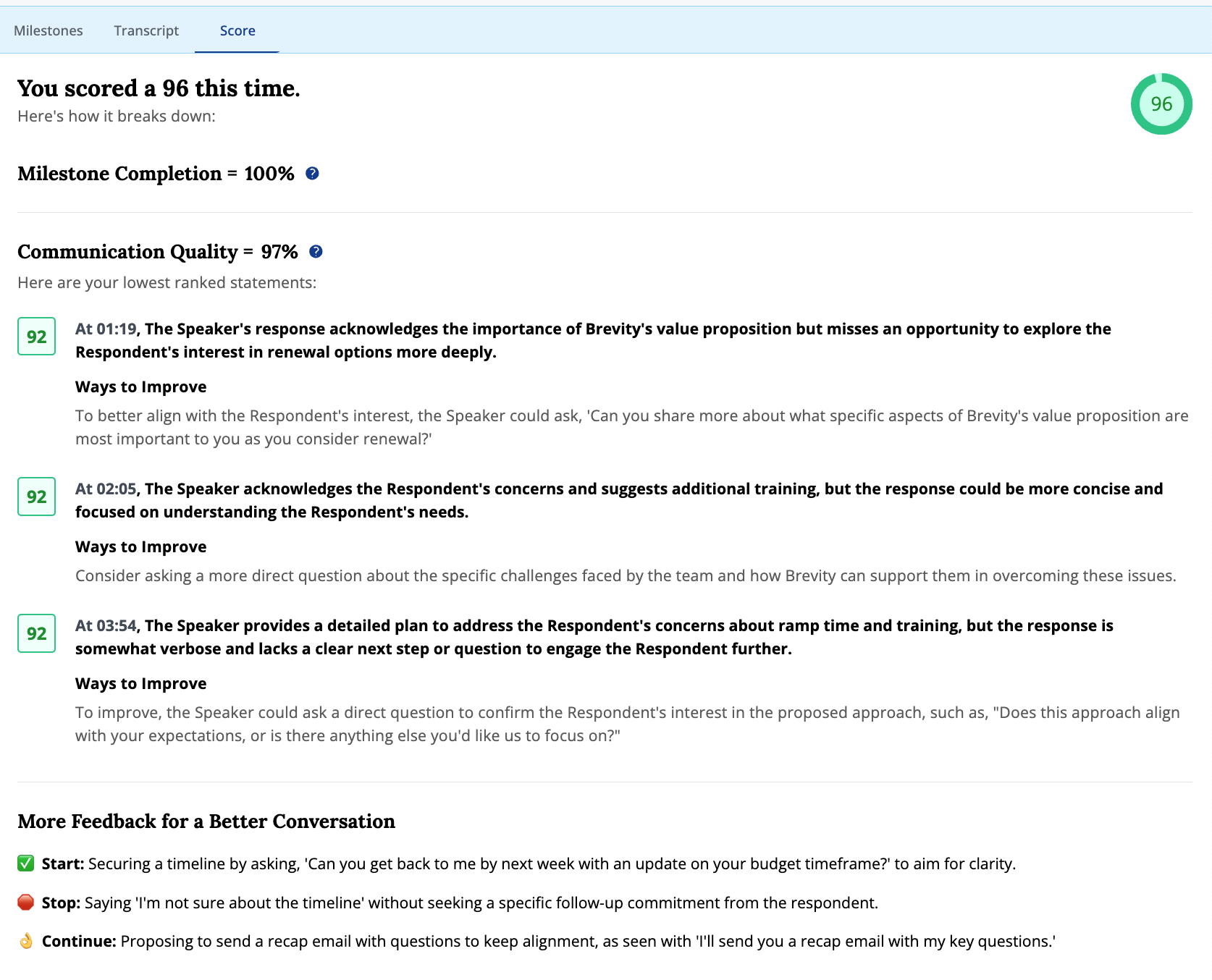
Tip: For more detail on how your score was calculated, hover over the final score in the top right corner of your score report or the question mark icons in the Milestone Completion and Communication Quality sections.
Here’s how it works:
1. Milestone Score
- Milestones are key objectives you need to achieve in your scenario (e.g., build rapport, uncover pain, etc.).
- Each milestone is binary: you either pass it and receive full credit for that milestone or you do not.
- The target milestone (usually the main goal, such as scheduling a demo or closing the conversation) is weighted heavily—worth 30% of your total milestone score.
- The remaining milestones share the remaining 70% equally.
2. Communication Quality
- Each statement or response you make during the role play receives a score.
- Your average statement score for the call is calculated and used as part of your final score.
3. Combining the Scores
- Your overall score is a weighted combination of your Milestone Score (typically higher weight) and your Average Statement Score.
Example Calculation
Suppose you completed a role play with 5 milestones:
- You passed 4 out of 5 milestones, including the target milestone.
- Your average statement score was 72.
Step 1: Calculate Milestone Score
- Target milestone: 30% (since you passed it, you get the full 30%)
- Other 4 milestones: Share remaining 70% equally
- Each is worth 17.5% (70% ÷ 4)
Let's say you missed one non-target milestone.
Milestone score breakdown:
- Target milestone: 30% (passed)
- 3 other milestones: 3 × 17.5% = 53% (passed)
- 1 missed milestone: 0% (not passed)
Total milestone score = 30% (target) + 53% (other passed) = 83%
Step 2: Calculate Overall Score
The overall score is calculated as a weighted combination. (Each organization may set these weights, but here’s a typical example with equal weighting):
- Milestone Score: 83%
- Average Statement Score: 72%
If the scores are averaged equally:
- Overall Score = (0.83 x 0.72) = 0.6
Your final score for this role play would be 60%.
In summary: Passing milestones—especially the target milestone—has a significant positive impact on your score. Consistently passing all milestones and delivering high-quality statements is the best way to maximize your performance in Brevity.
Why This Scoring Model Works
Brevity’s scoring model is designed to reflect true real-world selling performance. By weighting the target milestone most heavily—and awarding proportionate credit for other core objectives—this approach ensures the primary goal of each conversation drives your score, just as it does in actual sales calls. At the same time, it encourages consistent performance on all call steps, not just the end result.
Blending objective, binary milestone achievement with nuanced, per-statement feedback gives reps a holistic view:
- Milestone scores tell you if you’re hitting your call objectives.
- Statement scores highlight the quality and effectiveness of your delivery.
This model helps reps—and managers—pinpoint both the “what” (did I accomplish my call goals?) and the “how” (did I communicate well?), driving focused, actionable coaching and faster skill development.
How to Interpret your Scores
Scripts mode
Note: You’re expected to read and use the provided script. Statement scores below 90 usually mean you aren’t fully following it.
-
90–100: Phenomenal What it means: You closely followed the provided script, passed the target milestone, and delivered high-quality statements. Do next: Maintain what’s working. Challenge yourself with tougher scenarios, edge-case objections, and tightening openings/closings and time-to-win.
-
65–75: Good What it means: Solid fundamentals with some inconsistencies—often a missed non-target milestone or lower statement quality. In Scripts mode, scores in this range usually indicate you’re not fully reading or applying the script. Do next: Read the on-screen script verbatim or near-verbatim for key moments (open, discovery, close). Use Start/Stop/Continue to pick 1–2 habits to adjust, and aim to lift your average statement score by 5–10 points.
-
Below 60: Needs Work What it means: You’re likely missing the target milestone or multiple core milestones. In Scripts mode, this typically means you didn’t follow the provided script. Do next: Slow down and read the script exactly as provided. Practice short reps focused on openings, discovery questions, and the close. Use the rephrased examples to tighten clarity and direct asks.
Hints or None
-
81–85: Phenomenal
-
What it means: You’re consistently hitting core objectives, usually passing the target milestone with strong statement quality.
-
Do next: Maintain what’s working. Challenge yourself with tougher scenarios, edge-case objections, and tightening openings/closings and time-to-win.
-
-
65–75: Good
-
What it means: Solid fundamentals with some inconsistencies—often one missed non-target milestone or a lower average statement score.
-
Do next: Use Start/Stop/Continue to pick 1–2 habits to adjust. Revisit the milestone you miss most, and aim to lift your average statement score by 5–10 points.
-
-
Below 60: Needs Work
-
What it means: You’re likely missing the target milestone or multiple core milestones, and statements need polish.
-
Do next: Prioritize passing the target milestone first. Practice short reps focused on openings, discovery questions, and the close. Use the rephrased examples to tighten clarity and direct asks.
-
Why This Matters / Value to You
- See Progress: Track how you’re improving across practice sessions and over time.
- Targeted Practice: Instantly identify your strengths and weaknesses—no more guessing how you did.
- Faster Ramp: Build confidence and correct mistakes before going live with prospects.
- Organization Measurement: For managers—dashboard and reports make it easy to spot coaching opportunities.
FAQ
-
Can I review feedback later?
Yes! Return to the Assignment's page to revisit any previous calls and see all historical scoring and feedback. -
Why didn’t I “win” my call even though I passed most milestones?
To “win,” you must pass the target milestone—usually related to booking a meeting, handling the key objection, or reaching your goal for the scenario. -
My score seems low—should I be worried?
Early scores help you spot opportunity areas. Use the specific feedback to focus your next practice and watch your score rise! - Why can't I get above a 90?
Short answer: It depends on your practice mode and how closely your statements match the “perfect” reference.
-
Hints or None: Reaching above an 80 is HARD by design. In these modes there’s no provided script; each of your statements is compared to a “perfect” reference answer. Even very strong freeform responses earn partial credit, so 81–85 is considered phenomenal.
-
Scripts mode: 90–100 is possible, but only if you read and use the provided script. Your statements are evaluated against the script’s “perfect” phrasing; scores below 90 usually mean you’re paraphrasing, skipping lines, or adding filler that deviates from the script.
Other reasons your overall score stays below 90
- Target milestone missed: It carries heavy weight; missing it caps your overall score.
- Average statement score: Your overall score blends milestones with your average statement score. If that average is below 90, your overall will likely stay below 90.
- Non-target milestones: Missing any reduces the milestone portion and drags down the final score.
How to unlock 90+
- Use Scripts mode for attempts where 90–100 is your goal.
- Read the on-screen script verbatim at critical moments (opening, discovery questions, recap, close).
- Match the “perfect” phrasing to lift your average statement score to 90+.
- Pass every milestone, especially the target milestone.
- Review Start/Stop/Continue and the rephrased examples to tighten deviations and remove filler.
-