
Reps can now share their screen during a role play, and the AI partner reacts to what's on screen — pitch decks, product demos, live walkthroughs, anything they'd normally pull up on a real call. The AI sees the screen in real time, references what's being shown in conversation, and milestones can grade reps on what they did on screen. Practice finally looks like the way reps actually sell.
How it works
When a rep starts a role play, a screen share toggle is available alongside the other in-session controls. They pick which window or screen to share, just like on any video call. The AI partner picks up the change within a few seconds and starts referencing what's on screen — "I see you're on the pricing slide; walk me through the mid tier?" — and the conversation adjusts from there.
Reps can turn screen share on or off at any point during the session. When the role play ends, the screen share track ends cleanly with it — no manual cleanup, no lingering captures.
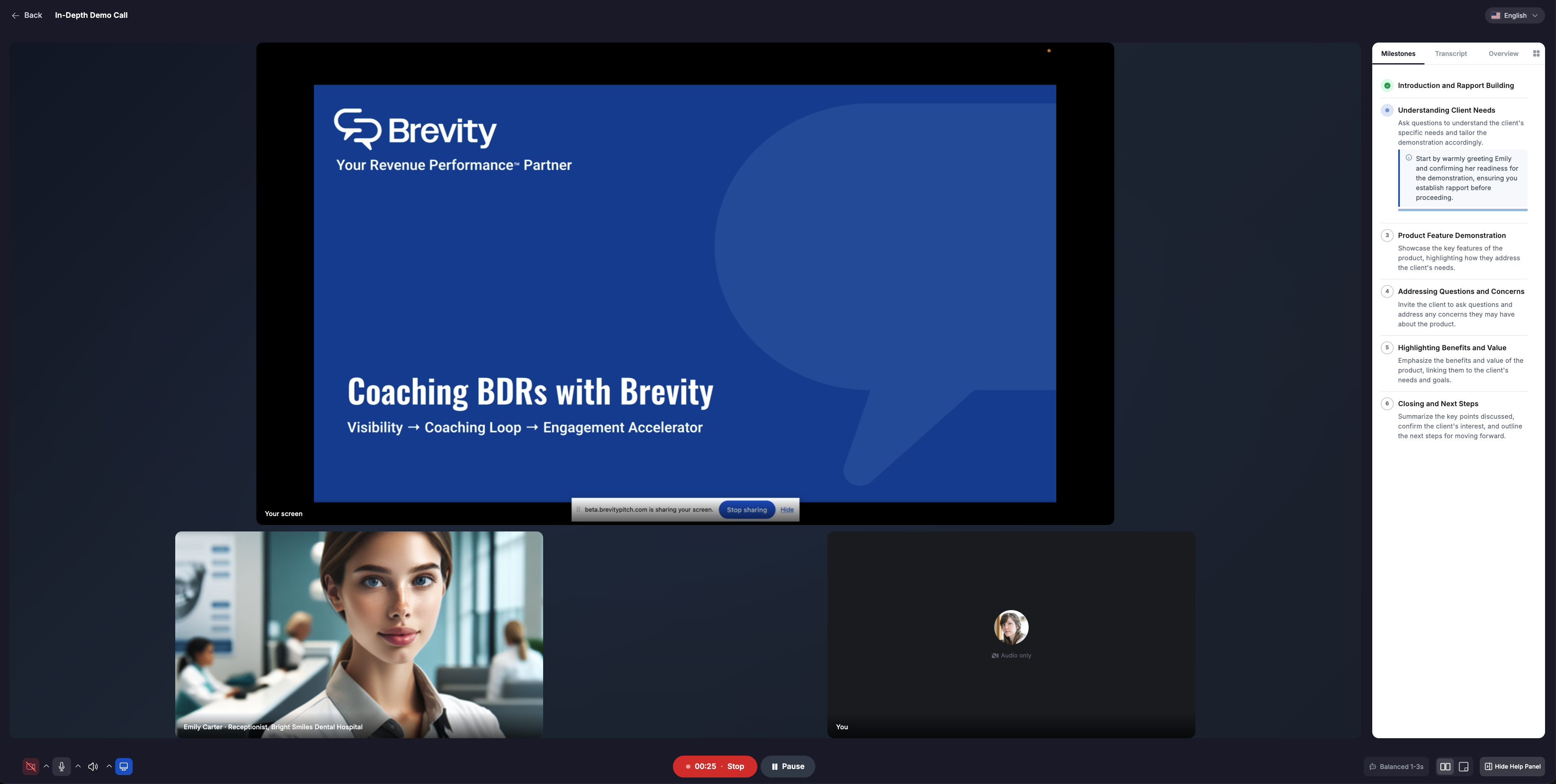
Milestone scoring on what's shown
When admins build a role play, milestones can be written around on-screen behavior alongside the conversational ones already supported. Useful patterns include:
- "Don't read directly from the slide." Catches reps who default to reading the deck instead of speaking to it.
- "Walk through the pricing visual." Confirms the rep actually narrated the slide that matters most.
- "Advance the deck without being prompted." Coaches reps who wait for the buyer to ask for the next thing.
The milestone grader receives the screen content alongside the transcript, so it can tell whether the rep performed the on-screen behavior — not just whether they said the words. Like other milestones, the score lands after the session alongside the rest of the feedback.
Review and recordings
The screen share is captured as its own stream alongside the standard camera and audio recording. When a manager opens the session for review, they see what the rep saw and said — the full picture, not just the conversation. No additional setup is required; if a rep used screen share during the session, it's there in the replay.
Requirements and availability
Screen share is desktop-only at launch and available for orgs on Brevity's LiveKit voice stack. If your org isn't on LiveKit, your CSM can walk through what enabling it looks like.
There's no per-rep configuration — once your org is eligible, the toggle is available to anyone running a role play. Admins who want to grade on-screen behavior add screen-aware milestones to their role-play scenarios; nothing else needs to change in how the scenario is set up.
Tips for getting good results
- Share the right window, not your full desktop. Cleaner background, cleaner replay, fewer distractions in scoring.
- Talk through what's on screen, don't read it. The AI is built to coach the difference, and milestones can catch it.
- Move at a reasonable pace. The AI picks up screen changes within a few seconds; rapid-fire slide flipping may outpace it.
- Keep slides legible. The AI grades what it can see — tiny fonts or low-contrast slides make on-screen scoring harder.
What's not in this launch
A few things to set expectations on:
- Mobile. Screen share is desktop-only at launch.
- Real-time on-screen feedback. Scores still arrive after the session ends, the same as today.
- Per-slide content accuracy scoring. Milestones grade on-screen behavior (did the rep do the thing) — not whether the content of a specific slide was correct.